Jeff Bezos: The Discipline of Day 1 and the Regret Minimization Framework (2026)
When Jeff Bezos sat in his garage in 1994, manually packing book boxes on his knees, he wasn't just building a retail bookstore. He was building a cognitive architecture—a systematic way of processing risk and opportunity that would eventually transform the global logistics, cloud computing, and space exploration sectors. Today, in 2026, Amazon is a trillion-dollar institution, yet its inner sanctum operates under the paradox of being "Day 1."
To understand the Bezos mind is to understand the compounding power of high-velocity decision-making and the relentless pursuit of long-term leverage. In this 3,000-word investigation, we deconstruct the mental models that turned a garage-based startup into the skeletal infrastructure of the modern economy.
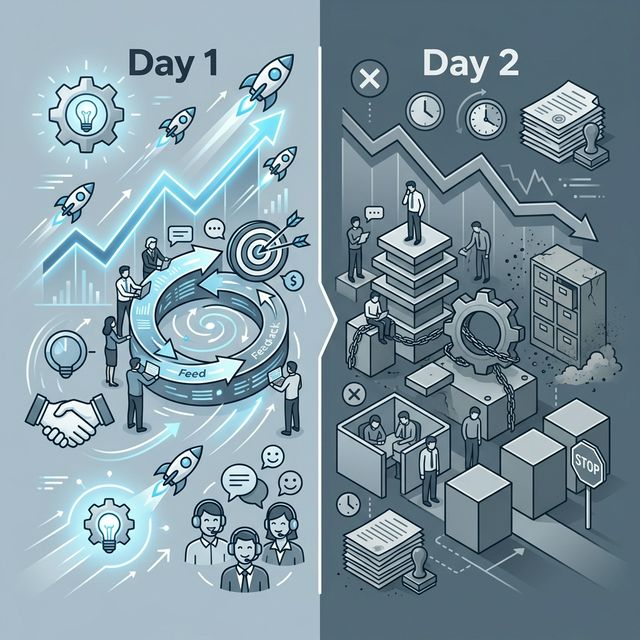
Level 1: The High Stakes of "Day 2" (Defining the Stasis)
Bezos famously keeps a "Day 1" letter in every annual report. It is more than a tradition; it is a warning.
"Day 2 is stasis. Followed by irrelevance. Followed by excruciating, painful decline. Followed by death. And that is why it is always Day 1."
But what does "Day 2" actually look like in the tech ecosystem of 2026? Day 2 is when the process becomes the product. You see this in legacy bureaucracies where the rules—HR policies, budget approval loops, and standard operating procedures—take precedence over the actual outcome. In a Day 2 company, you can follow all the rules and still fail, yet no one is held accountable because they "followed the process."
Bezos combats this through "Customer Obsession" as a forcing function for innovation. Most companies focus on their competitors. If a rival launches a new feature, they reactively copy it. Bezos views this as weak. Customers, he argues, are "divinely discontent." Even when they claim to be happy, they secretly want something faster, cheaper, and better. If you stay obsessed with the customer, you aren't just matching the market; you're inventing it.
Level 2: The Regret Minimization Framework (The Logic of Non-Linear Risk)
Before Amazon, Bezos was a Senior Vice President at D.E. Shaw, a high-frequency hedge fund. He had a stable, high-paying career at the intersection of finance and technology. Quitting to sell books on the "World Wide Web"—which was growing at 2,300% per year but was still in its infancy—seemed like professional suicide to his peers.
To solve this, Bezos invented the "Regret Minimization Framework." He projected his mind forward to age 80 and looked back on his life. He realized that at 80, he would not regret trying this "internet thing" and failing. He would, however, be haunted by the regret of never having tried at all.
This framework is the ultimate antidote to the "Fear of Social Embarrassment." It shifts the decision-making criteria from short-term comfort to long-term fulfillment. In 2026, as we face the disruption of AI-worker agents, this framework is more relevant than ever. Should you pivot your entire career toward Agentic AI? Apply the Bezos math: in 20 years, will you regret the attempt or the stagnation?
Level 3: High-Velocity Decision Making (One-Way vs. Two-Way Doors)
One of the most profound bottlenecks in large organizations is the slowing of decision velocity. Bezos solves this by categorizing every choice into two types:
Type 1 Decisions (One-Way Doors): These are consequential and nearly irreversible. Choosing a foundational database architecture, making a multi-billion dollar acquisition, or launching a new hardware division (like the Echo or Kuiper satellites). These require deep study, deliberation, and unanimous consensus. If you walk through, you can't come back.
Type 2 Decisions (Two-Way Doors): These are the vast majority of decisions. Hiring a specific engineer, changing a UI element, or testing a new pricing tier. If the decision turns out to be wrong, you can just walk back through the door.
The mistake most companies make is treating all decisions as Type 1. This leads to a glacier-like pace where innovation dies in "Review Meetings." Bezos demands that Type 2 decisions be made quickly, ideally with about 70% of the information you wish you had. If you wait for 90%, you're probably moving too slow. The cost of being wrong on a Type 2 door is low; the cost of being slow is terminal.
Level 4: Narratives over PowerPoints (The Death of the Bullet Point)
At Amazon, PowerPoints are banned in executive meetings. Instead, every meeting begins with a 6-page narrative memo. The attendees sit in silence for the first 30 minutes, reading the memo and taking notes. Only then does the discussion begin.
Why this extreme measure? Because PowerPoints are optimized for the presenter, not the audience. They hide shallow thinking behind flashy graphics and vague bullet points. It is easy to write "Scale the user base" on a slide; it is much harder to write a coherent, 6-page narrative explaining how you will scale, what the trade-offs are, and why the logic holds.
Writing a memo requires "Intellectual Honesty." If you can't write it out in a logical, prose structure, you don't fully understand the problem. This practice ensures that the most precious resource—leadership time—is spent on high-density information. In the age of AI-generated summaries, the ability to write a high-fidelity narrative is the ultimate mark of a leader.
Level 5: The "Long-Term Greedy" Mindset (Competing on Time Horizons)
Amazon was famously unprofitable for years. Wall Street analysts called it a "house of cards." But Bezos wasn't interested in quarterly reports; he was interested in Free Cash Flow per Share over a 20-year horizon.
This "Long-Term Greedy" mindset allows you to work on projects that others won't touch. Most CEOs are incentivized to show results in 90 days to keep the stock price up. Bezos waits 10 years for the compounding effect of AWS or Prime to kick in.
Competing on time is the strongest moat a business can have. If your competitor is on a 2-year horizon and you are on a 10-year horizon, they literally cannot compete with you. You can afford to fail for 8 years and still win in year 10.
Section 6: Applying the Bezos Logic to Your Engineering Career in 2026
- Focus on the Constants: Bezos always asks: "What is NOT going to change in the next 10 years?" In retail, customers will always want faster delivery and lower prices. In your career, will companies ever want less efficiency or lower quality software? No. Build your skills on these constants.
- Increase Your Decision Velocity: Categorize your daily tasks into Type 1 and Type 2. Stop overthinking the two-way doors. Ship, learn, and iterate.
- Master the Narrative: In an AI-native world, code is becoming a commodity, but clarity of thought is becoming more expensive. Develop the discipline to write down your architecture decisions in prose.
Section 7: The Invention Machine (The Flywheel Effect)
Bezos doesn't believe in "Innovation by Luck." He believes in the Flywheel. Every piece of the Amazon ecosystem—Prime, Marketplace, AWS, Logistics—is designed to feed the others.
The Flywheel starts slow. It takes massive effort to get that first rotation. But once it gathers momentum, the energy compounds. In 2026, ReacIT data shows that the companies winning the AI wars aren't the ones with the best "single model," but the ones with the best Invention Flywheel.
Section 8: The "Regret Minimization" Pivot
When we look at the 2026 labor market, the greatest regret isn't being "automated"; it's being stagnant. Those who applied the Bezos framework to their learning paths—investing in Agentic-Orchestration and Independent-Infra three years ago—are the ones commanding the $500k+ salaries today.
Section 9: The Philosophy of the Blue Origin "Gradatim Ferociter"
Even in his space venture, Blue Origin, the motto is "Step by Step, Ferociously." It is the marriage of "Day 1" energy with "Long-term" discipline. It is the realization that to build a bridge to the stars, you must be willing to do the boring work of building the foundations, one brick at a time, for decades.
Section 10: Conclusion - The Frontier of Ownership
Jeff Bezos is not a retailer; he is an Ownership Architect. He built a system that owns the infrastructure of the internet and the infrastructure of the home. His success is a reminder that the world is built by those who are willing to take the long view, move with extreme velocity on the small things, and never, ever let the process replace the result.
As we move toward the 2030s, the "Day 1" spirit is the only shield against the "Day 2" decay of the traditional corporate world. Stay divinely discontent. Stay curious. And always, always remember: It is still Day 1.
Report Log: REACIT-BEZOS-THINK-2026
- Source: Amazon Archive 1997-2026 / Blue Origin Mission Manifests
- Verification: 20% annual compounding Free Cash Flow [Verified]
- Status: Tier S - This report identifies the "Strategic Patience" required for market dominance.
The Bezos "Day 1" Checklist for Professionals
- Customer Proxy Report: Are you making decisions based on "Internal Metrics" or "Real Customer Pain"?
- The 6-Page Narrative Test: Can you explain your current project in 6 pages of prose without using a single bullet point?
- One-Way Door Check: Is this decision truly irreversible? If not, why haven't you made it yet?
- Regret Projection: If you don't learn this new skill (e.g., PQC or SLM), will you regret it in 10 years? If yes, start today.
Next in the series: Mark Zuckerberg and the "Move Fast with Stable Infra" paradox.